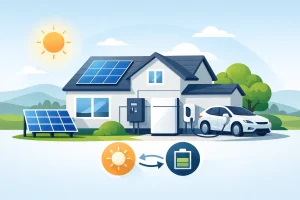

Your utility bill usually tells the story before anything else does. If your building uses a lot of power during the day, rates keep climbing, and your roof is sitting there doing nothing, this commercial rooftop solar guide is the right place to start.
For many businesses, rooftop solar is not really an environmental decision first. It is an operating cost decision. The question is simple: can you turn unused roof space into long-term savings without creating headaches for your property, tenants, or operations? In many cases, yes. But the right answer depends on your roof, your load profile, your financing strategy, and how well the project is designed from day one.
What a commercial rooftop solar guide should help you decide
A good commercial rooftop solar guide should not just tell you solar is a smart investment. It should help you figure out whether it makes sense for your specific property.
Commercial systems work best when a building has strong daytime energy use, predictable occupancy, and utility bills that justify the upfront investment. Warehouses, retail centers, office buildings, manufacturing sites, schools, and mixed-use properties can all be strong candidates. What changes from one property to the next is the financial structure and system design.
For owner-occupied buildings, the value is often straightforward. Solar can lower monthly electricity costs, create more budget predictability, and improve the economics of holding the property over time. For leased or multi-tenant properties, it gets more nuanced. You need to think through who pays the utility bill, how savings are allocated, and whether solar supports tenant retention or property value.
Start with the building, not the panels
The biggest mistake commercial property owners make is shopping for panel wattage before confirming the roof and electrical infrastructure can support the project.
Roof age matters. If your roof is near the end of its service life, installing solar first can create unnecessary cost later when the system has to be removed and reinstalled for roof work. That is why experienced providers look at roof condition early, not as an afterthought. In some cases, combining roofing and solar into one project makes the numbers and the logistics work better.
Roof type matters too. Flat roofs are common on commercial buildings and often work well because arrays can be positioned for production and service access. Pitched roofs can also perform well, but penetrations, setbacks, and layout constraints may affect system size. Shade from adjacent buildings, HVAC units, parapets, and rooftop equipment can reduce output if the design is not carefully modeled.
Then there is the electrical side. Your service size, panel condition, interconnection setup, and load distribution all influence what the system can do. A building with high annual usage but limited usable roof area may not offset as much as the owner expects. A building with a great roof but modest energy consumption may still benefit, but the payback profile will look different.
How savings actually work
Commercial solar economics are stronger when the system is sized around real consumption patterns rather than a rough estimate. The goal is not always to cover 100 percent of usage. In fact, oversizing can hurt the return if excess production is credited at a lower value than the electricity you are avoiding during business hours.
Most businesses benefit from offsetting the most expensive electricity first. That may include high daytime usage, demand-related costs, or seasonal peaks. If your utility rate structure includes demand charges, battery storage may deserve a serious look alongside solar. Solar alone reduces energy purchases, but storage can help control when electricity is used and, in some cases, lower costly peaks.
The strongest projects are built on interval data, utility bill analysis, and realistic production modeling. That kind of detail matters because a solar proposal should answer business questions, not just engineering questions. What is the expected annual savings? How long is the payback? What assumptions are being used for utility inflation? What happens if occupancy changes? A serious provider should walk through those points clearly.
Costs, incentives, and financing
Commercial rooftop solar is capital-intensive, but that does not mean every project needs a large cash payment upfront. Some businesses prefer direct purchase because it typically delivers the strongest long-term return. Others prioritize preserving capital and choose financing structures that spread costs over time.
A purchased system generally offers the greatest lifetime value because the owner captures the energy savings directly and may also benefit from available tax incentives and depreciation advantages, depending on tax appetite and project structure. Financing can still pencil out well if monthly savings exceed debt service or if the business values immediate cash-flow improvement.
Third-party ownership models can make sense for some organizations, especially when minimizing upfront cost is the top priority. The trade-off is that the project economics are shared with the financing partner. That does not make it a bad option. It just means the right structure depends on whether your priority is maximum return, low initial spend, accounting treatment, or speed of adoption.
Incentives can materially improve project economics, but they should be explained carefully. The available value depends on project type, location, tax status, and current policy. Businesses should evaluate incentives as part of the model, not as the only reason to move forward. A project should still stand up on the fundamentals: utility savings, roof suitability, and long-term property plans.
Why design and installation quality matter more in commercial projects
Commercial rooftops are busy. You may have mechanical equipment, drainage paths, access lanes, structural limits, tenant concerns, and strict local requirements all competing for space. That is why commercial solar is not just a scaled-up version of residential solar.
A well-designed system protects the roof, respects fire and service setbacks, preserves maintenance access, and is built for long-term uptime. Poor layout decisions can complicate roof repairs, reduce production, or create service issues that cost more over time than they saved upfront.
This is where a full-service partner matters. If your provider can assess roof condition, handle design, coordinate permitting, manage utility interconnection, install the system, and support ongoing service, the project is easier to control and easier to trust. LA Solar Group built its model around that kind of end-to-end execution because commercial customers do not want to juggle multiple vendors for one energy project.
Timeline and what to expect
Commercial clients often ask how long rooftop solar takes. The honest answer is that installation is only one part of the timeline.
Site review, engineering, utility coordination, permitting, procurement, and inspections can each affect schedule. A relatively straightforward project may move quickly, while a system with utility upgrades, structural questions, or multi-agency approvals can take longer. That is normal. What matters is having clear project management and realistic expectations.
The best process starts with a detailed assessment. That includes reviewing utility bills, roof condition, satellite and on-site measurements, electrical infrastructure, and your operating goals. From there, you should receive a proposal that explains estimated production, cost, savings, assumptions, and scope. If those numbers look attractive, the next phase is engineering and approvals, followed by installation and final permission to operate.
Common reasons projects stall
Some commercial solar projects do not fail because solar is a bad fit. They stall because basic issues were missed early.
The roof may need work sooner than expected. The building may not have enough usable area to hit the desired offset. The ownership group may not align on whether to prioritize cash flow or long-term return. Utility interconnection may be more complex than the initial proposal suggested. None of these issues are deal-breakers by themselves, but they need to be surfaced early.
That is why careful planning is worth more than a fast quote. A low number on page one means very little if the design changes later, the assumptions are unrealistic, or the provider cannot support the system after installation.
Is your building a strong candidate?
A strong commercial rooftop solar candidate usually has three things: meaningful daytime energy use, a roof with enough viable space and life remaining, and an ownership team that wants lower operating costs over the long term.
If your business also wants better resilience, battery storage may strengthen the case. If your property is part of a broader upgrade plan, solar can pair well with roofing improvements, EV charging, and electrical modernization. The point is not to force every building into the same solution. It is to build the right one for the property and the financial goals behind it.
The right project should feel practical. Lower bills, better control over energy costs, and a roof that finally starts earning its keep. If your building has the load and the space, commercial rooftop solar can do exactly that – and the first smart move is a serious evaluation based on real numbers, not guesswork.