Sticker shock is often the moment people pause on solar. Not because the math stops working, but because a system that saves money over time still has to be paid for upfront. That is exactly why understanding how solar financing works matters. The right financing structure can turn a large purchase into a manageable monthly payment, often while keeping total energy costs lower than what you are paying the utility.
For most homeowners and business owners, solar financing comes down to one question: do you want the lowest upfront cost, the highest long-term return, or the most predictable monthly payment? Each path can make sense. The best option depends on your tax situation, cash flow, property plans, and how much control you want over the system.
How solar financing works in simple terms
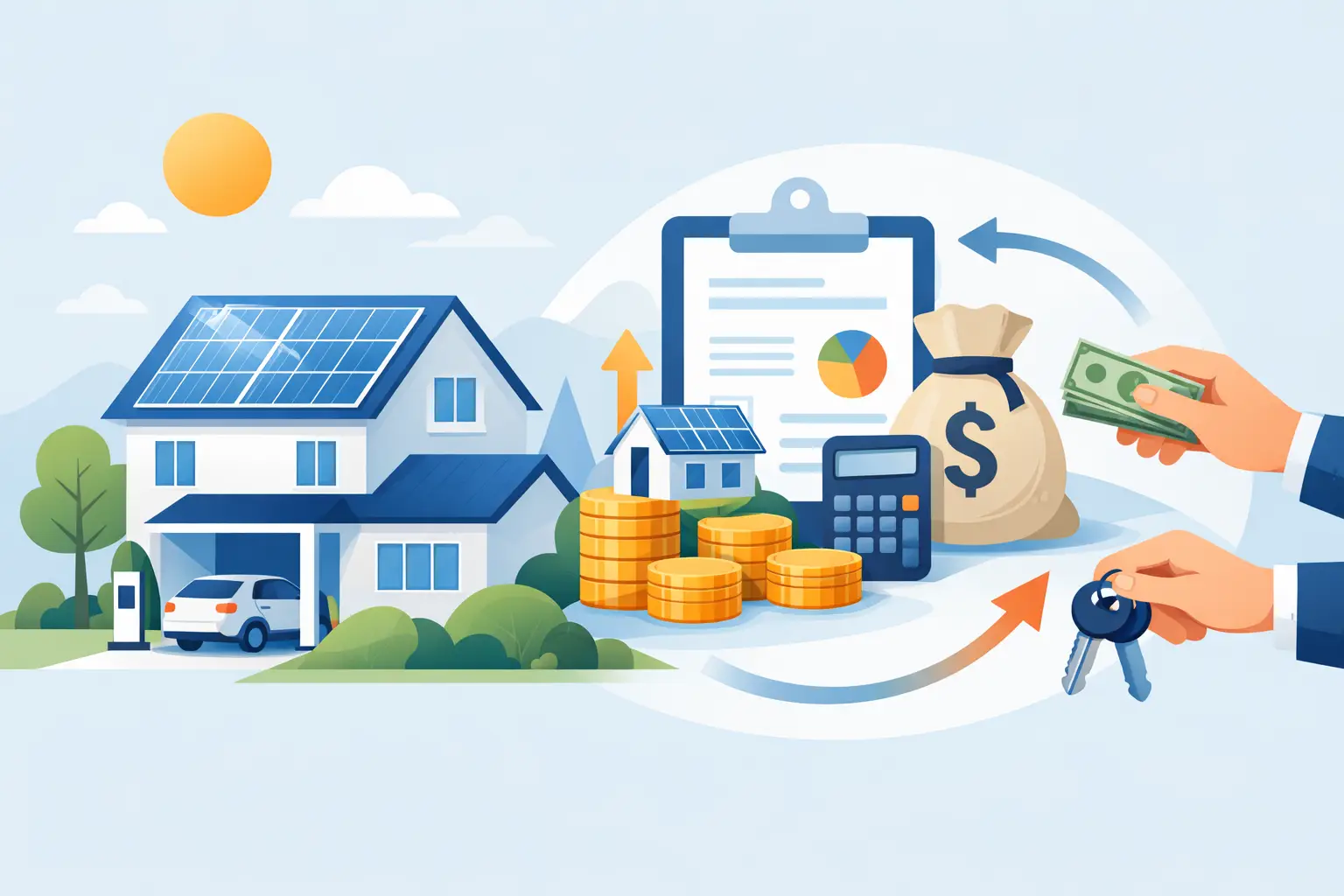
At its core, solar financing spreads the cost of a solar energy system over time instead of requiring full payment on day one. Depending on the structure, you either own the system and make payments toward it, or a third party owns it and you pay for access to the energy it produces.
That distinction is the part that affects almost everything else. Ownership usually brings the biggest long-term savings and access to tax incentives. Third-party options usually reduce upfront costs and can simplify the decision, but they may limit incentives and total savings over the life of the system.
A financing proposal typically includes the system price, estimated monthly payment, interest rate or payment escalator if applicable, term length, projected utility savings, and any assumptions tied to tax credits. If battery storage, roofing, an EV charger, or a main panel upgrade are part of the project, those can often be wrapped into the same financing package.
The main ways solar financing works
Solar loan
A solar loan is the closest thing to traditional ownership without paying cash. You borrow money to pay for the system, then repay the lender in monthly installments over a fixed term. Once the system is installed, you own it, which means the equipment is part of your property and you benefit directly from the electricity it generates.
This is often the strongest fit for customers who want to maximize long-term savings but prefer to avoid a large upfront payment. Many loans offer fixed monthly payments, and some are structured with little or no money down. Over time, your loan payment may be lower than your former utility bill, especially in high-rate markets.
There are trade-offs. The interest rate affects the true cost of the system, and some financing offers include dealer fees that raise the total project price. You also need to qualify based on credit and income. If the financing assumes you will apply the federal tax credit toward the loan balance, your payment may increase later if that prepayment does not happen.
Solar lease
With a solar lease, a third-party company owns the system and installs it on your property. You pay a fixed monthly lease payment in exchange for using the equipment and the electricity it produces.
This option appeals to customers who want a low barrier to entry and predictable payments. It can be a practical choice when preserving cash is the top priority. Maintenance responsibilities may also be simpler, depending on the lease terms.
The trade-off is that you usually do not receive the tax credit or the full financial upside of ownership. Since you do not own the system, your long-term savings are often lower than with a loan or cash purchase. Lease contracts also need careful review, especially around annual payment increases, transfer terms if you sell the property, and end-of-term options.
Power purchase agreement
A power purchase agreement, or PPA, is similar to a lease, but instead of paying a set equipment payment, you pay for the electricity the system produces at an agreed rate per kilowatt-hour. That rate is often lower than the local utility rate, which creates immediate savings.
PPAs can work well for customers focused on lowering current energy costs with little or no upfront investment. For some commercial properties, they can also support cash flow planning by tying costs more directly to production.
Like a lease, a PPA generally means the third party owns the system and claims the incentives. It also introduces another variable: production. If your contract includes an escalator, the energy rate can rise over time, so a low starting price does not always mean the best long-term deal.
What lenders and providers look at
If you are financing an owned system, approval usually depends on your credit profile, debt-to-income ratio, property details, and project scope. For commercial customers, lenders may also review business financials, operating history, and the expected performance of the system.
The property itself matters too. Roof condition, shade, electrical infrastructure, and utility usage all influence system size and total project cost. If your roof needs work before installation, or if you want to include a battery and electrical upgrades, that changes both the financing amount and the savings timeline.
This is one reason turnkey providers have an advantage. When one company can evaluate solar, storage, roofing, and panel capacity together, the financing conversation becomes more accurate from the start.
Incentives change the numbers
One of the biggest reasons solar financing works so well for many US property owners is that incentives can materially reduce net system cost. The federal solar tax credit is the most widely known example. For eligible owners, it can offset a meaningful percentage of the installation cost.
That said, the tax credit is not the same as a rebate check at installation. It is a tax incentive, and whether you can use all of it depends on your individual tax liability. That is why financing illustrations based on tax credit assumptions should be reviewed carefully. If you cannot claim the full amount or cannot claim it in the expected timeframe, your payback picture may look different.
State and local programs can also affect value. Some areas offer rebates, performance incentives, property tax protections, or favorable net metering policies. These vary widely by market, which is why a financing plan that looks great in California may not pencil out the same way in Texas or Nevada.
How to compare financing offers without getting misled
The monthly payment is not the only number that matters. In fact, it can be one of the easiest numbers to manipulate. A longer term can make the payment look attractive while increasing the total amount paid over time.
A better comparison looks at the full project price, term length, interest rate, total repayment amount, expected utility offset, and what happens if you sell the property. For leases and PPAs, you should also review escalators, buyout terms, service responsibilities, and contract transfer requirements.
It helps to ask a simple question: what am I paying in year one, year ten, and year twenty-five? That reveals far more than a single monthly payment shown on a proposal.
When ownership makes the most sense
If you plan to stay in the property, have sufficient tax appetite for available credits, and want the strongest lifetime savings, ownership is usually the better financial move. Paying cash produces the highest return because there is no financing cost. A loan often comes next, especially when the monthly payment is comfortably offset by utility savings.
Ownership also tends to make more sense when you want to add battery storage, EV charging, or other home electrification upgrades as part of a broader long-term plan. You are building equity in your energy system instead of renting access to it.
When third-party financing can still be the right move
Not every customer wants to prioritize lifetime return. Some want to start with no money down, avoid using credit capacity, or keep monthly obligations as flexible as possible. In those cases, a lease or PPA may still be a smart path if the contract is competitive and the terms are clear.
This is especially true when utility rates are high and rising, or when the alternative is delaying solar for years while continuing to pay the utility. The right financing option is not always the one with the biggest theoretical savings. It is the one that fits your budget, timeline, and risk tolerance well enough to move forward confidently.
For homeowners and businesses evaluating proposals, the goal is not just to ask how solar financing works. It is to ask which version of it works for your property, your finances, and your long-term plans. A strong provider should be able to show you the numbers clearly, explain the trade-offs honestly, and build a system that makes financial sense from day one. If the proposal does that, solar stops feeling like a big expense and starts looking like what it really is – a controlled energy investment with room to pay you back for years.