
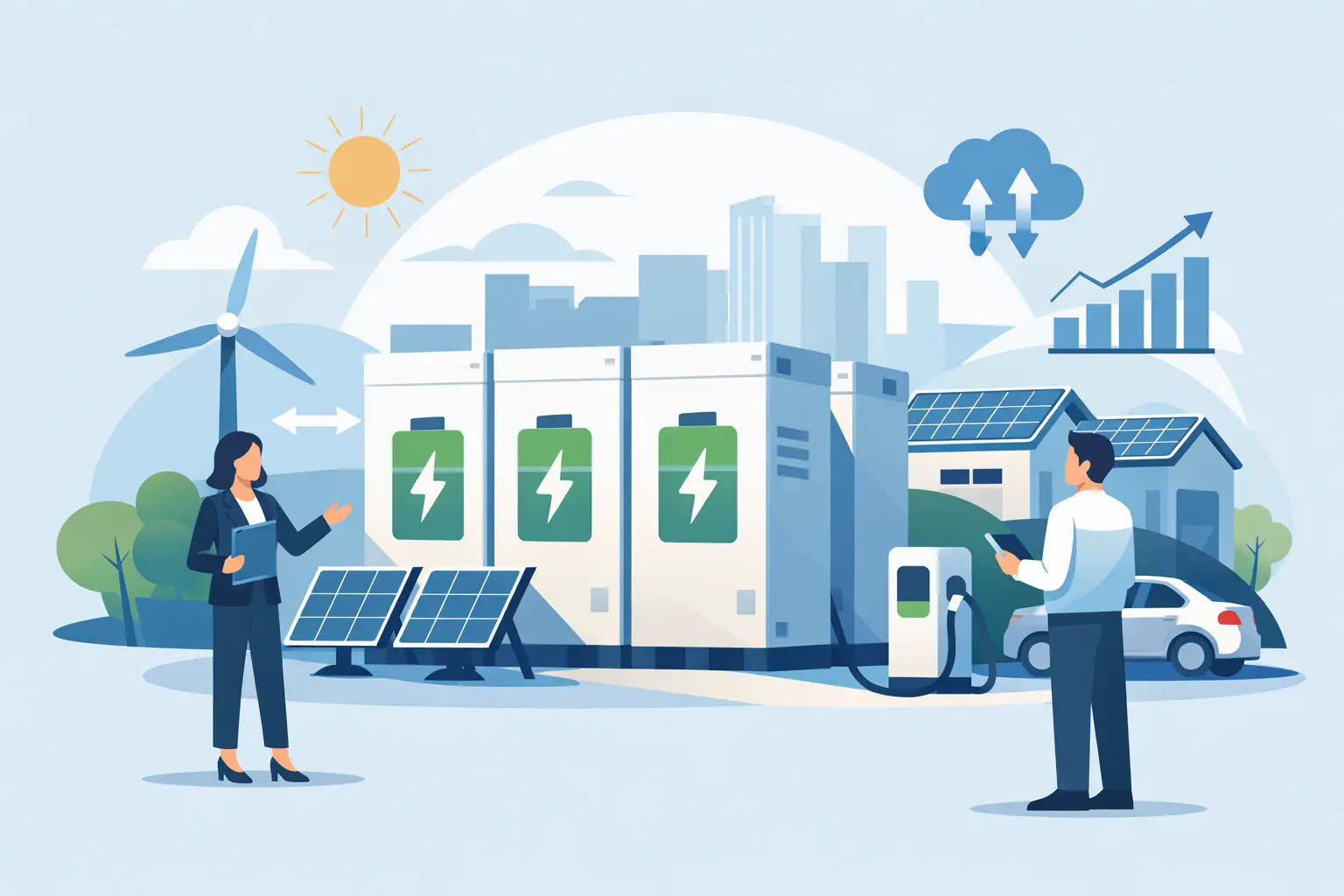
A single 15-minute demand spike can set part of a commercial utility bill for the entire month. For businesses with high peak usage, expensive time-of-use periods, or operations that cannot tolerate an outage, a battery is not simply backup equipment. This commercial battery storage guide explains how to assess whether storage can reduce costs, protect operations, and strengthen the value of a solar investment.
Commercial battery storage works best when it is designed around a facility’s actual load profile and utility rate structure. The right system may lower peak demand, shift energy use away from costly hours, keep essential equipment running, or do all three. The wrong approach is sizing a battery based only on square footage or choosing capacity without first understanding how the business buys electricity.
What Commercial Battery Storage Does for a Business
A commercial battery stores electricity for use when power is most valuable. It can charge from on-site solar, the utility grid, or both, then discharge according to a programmed operating strategy. That strategy is where the financial value is created.
For many businesses, the primary opportunity is demand-charge management. Demand charges are based on the highest level of electricity a facility draws during a billing interval, often measured in 15-minute increments. A battery can discharge during those short, high-use periods to reduce the peak seen by the utility. Even a modest reduction can create meaningful recurring savings when demand charges are high.
Time-of-use arbitrage is another common application. The battery charges when grid electricity is less expensive or when solar production exceeds the building’s immediate needs. It then supplies energy during late-afternoon and evening periods when utility rates rise. This is particularly useful for offices, retail locations, multifamily properties, warehouses, and other facilities facing time-varying rates.
Backup power adds a different kind of value. During a grid outage, a properly designed battery system can support selected critical loads, such as refrigeration, security, communications, IT equipment, emergency lighting, medical devices, or essential production equipment. Full-facility backup is possible in some cases, but it requires more battery capacity, higher inverter output, and careful planning around large loads such as HVAC systems, elevators, and motors.
Commercial Battery Storage Guide: Start With Your Load Data
The best commercial storage projects begin with interval data, not product brochures. At minimum, review 12 months of utility bills. Better still, obtain 15-minute or hourly interval data from the utility. This reveals when the facility peaks, how often those peaks occur, whether they coincide with high-rate periods, and how much solar can contribute.
A facility with a predictable afternoon peak may be an excellent candidate for battery storage. A business whose demand spikes are rare, unpredictable, or caused by large motor starts may need a more specialized design. Battery storage can still help, but the system must have sufficient power output to respond quickly and sufficient usable energy to sustain the discharge event.
It is also important to separate energy use from demand. A building may consume a moderate amount of electricity overall yet pay large demand charges because of a few short peaks. Conversely, a high-energy-use facility may not see strong demand-charge savings if its load stays relatively flat. The utility tariff, not total annual consumption alone, determines much of the storage opportunity.
Questions a Site Assessment Should Answer
A qualified assessment should determine the facility’s highest-demand intervals, its time-of-use rate periods, existing solar production, critical loads, backup duration targets, and electrical service constraints. It should also identify future changes, such as EV charging, expanded operating hours, new refrigeration equipment, or planned tenant improvements.
This forward-looking view matters because batteries are long-term assets. A system that fits today’s load profile but cannot accommodate a planned expansion may not deliver the expected return. In some situations, designing an expandable system is the smarter choice, even if the business installs only part of the capacity at the start.
Size the Battery for Power and Energy
Commercial battery sizing involves two different measurements: power and energy. Power is measured in kilowatts, or kW, and determines how much load the battery can support at one time. Energy is measured in kilowatt-hours, or kWh, and determines how long it can provide that support.
A business trying to trim a 100 kW demand spike may need a battery with enough power to discharge near that level, even if the spike only lasts 15 minutes. A business seeking four hours of backup for a 25 kW critical-load panel needs enough usable energy for roughly 100 kWh, plus an appropriate margin for system losses, battery reserve settings, and future load growth.
These goals often overlap, but they are not identical. A battery built mainly for demand shaving may have high power relative to its energy capacity. A backup-focused system may need more energy capacity and a carefully defined list of supported circuits. Solar can extend backup duration during daylight hours, but production changes with weather, season, and the time an outage begins. Backup planning should account for the least favorable conditions, not only a sunny summer day.
Pairing Storage With Commercial Solar
Solar and batteries are stronger together because solar creates a lower-cost source of electricity that the business can control. Without storage, excess midday solar production may be exported to the grid at a lower value than the cost of electricity later in the day. A battery can capture some of that production and use it when rates or facility demand are higher.
Still, adding a battery does not automatically make every solar project more profitable. The economics depend on export compensation, utility rates, demand charges, interconnection rules, battery pricing, incentives, and operating hours. In some cases, the best first step is to maximize rooftop solar. In others, especially where demand charges and evening rates are substantial, designing solar and storage as one integrated project can produce a better financial outcome.
The electrical design matters too. Solar inverters, battery inverters, switchgear, critical-load panels, and energy management controls must work together. A turnkey provider can coordinate these components, evaluate roof readiness, manage permitting and interconnection, and ensure the operating strategy matches the financial model. LA Solar Group brings that integrated approach to businesses that want solar, storage, and electrical upgrades managed through one experienced team.
Understand the Economics Beyond the Equipment Price
The installed price of a commercial battery is only one part of the investment decision. A useful proposal should estimate savings from demand-charge reduction, time-of-use shifting, solar self-consumption, and outage-risk mitigation separately. Each revenue or savings stream should be based on reasonable assumptions rather than a best-case scenario.
For example, a grocery store may place a high value on keeping refrigeration and payment systems online during an outage. A manufacturing facility may value avoiding a costly production interruption. An office building may prioritize lower utility bills over extended backup. These benefits are real, but they should be evaluated in business terms, including avoided spoilage, downtime, lost revenue, and tenant service expectations.
Federal tax incentives and depreciation may improve project economics for eligible businesses. State, utility, and local programs can also affect the calculation, particularly in markets with grid reliability concerns or high peak pricing. Incentives change, have eligibility requirements, and may be limited by available funding, so they should be confirmed during project planning rather than assumed.
Financing can also shape the decision. A cash purchase may provide the strongest long-term return, while financing can preserve working capital and allow utility savings to offset part of the monthly payment. The appropriate structure depends on the company’s tax position, capital priorities, expected ownership period, and tolerance for upfront expense.
Plan for Controls, Safety, and Ongoing Service
A battery’s performance depends on its controls as much as its capacity. The energy management system needs clear instructions: preserve a reserve for outages, reduce demand peaks, discharge during high-rate periods, or prioritize solar charging. Those priorities can be adjusted over time as utility rates and facility operations change.
Commercial storage also requires proper site planning. Equipment location, ventilation or thermal requirements, access, fire-code compliance, utility interconnection, and emergency shutoff procedures all need to be addressed. For larger systems, coordination with the authority having jurisdiction and the local fire department may be part of the approval process.
After installation, businesses should monitor system performance against the original model. If demand peaks shift because of new equipment or changing schedules, the battery dispatch strategy may need adjustment. Regular service support, clear warranty coverage, and access to production and storage data help protect the investment over its operating life.
A commercial battery should earn its place in the facility, not sit idle waiting for a rare outage. Start with your utility data, define the loads and costs that matter most, and build a system around the way your business actually operates. That is how storage becomes a practical tool for lower bills, stronger resilience, and more control over your energy future.