A low monthly solar payment can look great on day one. Ten years later, the better choice is usually the one that gave you more control, stronger savings, and fewer surprises. That is why the solar lease vs loan decision matters more than most homeowners expect.
Both options can help you go solar without paying the full system cost upfront. But they work very differently. A lease is built around access and convenience. A loan is built around ownership and long-term value. If your goal is simply to avoid a large cash purchase, either can work. If your goal is to reduce lifetime electricity costs and improve the value of your property, the details matter.
Solar lease vs loan: the core difference
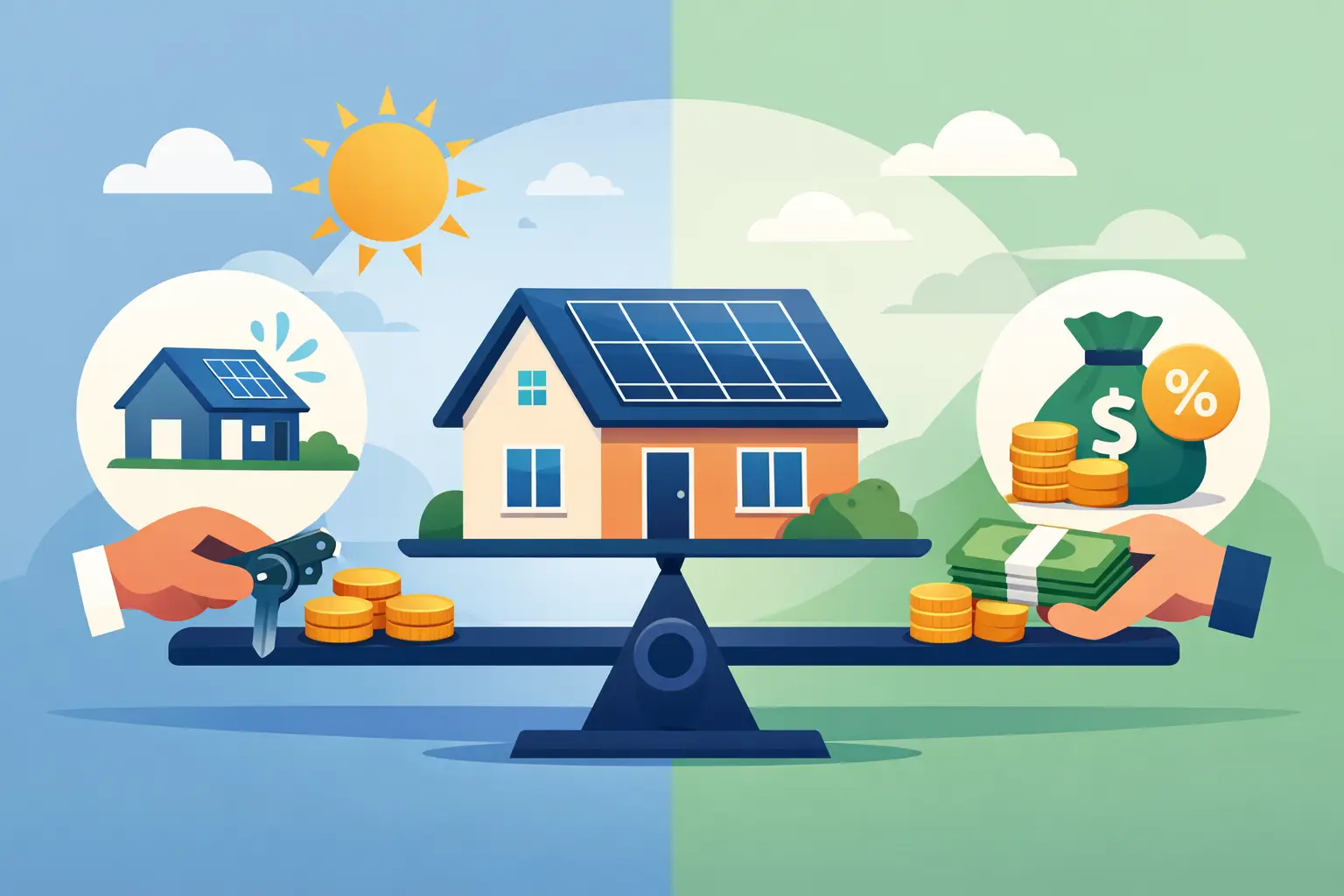
With a solar lease, a third-party company owns the system installed on your roof. You pay a fixed monthly amount, or sometimes a payment that increases over time, in exchange for using the power it produces. Because you do not own the equipment, you typically do not claim the federal tax credit or direct ownership-related incentives.
With a solar loan, you finance the purchase of the system and become the owner, usually from the start. You make monthly loan payments, but the system is your asset. That means you may be eligible for the federal solar tax credit and any applicable local incentives, and you benefit more directly from the long-term value the system creates.
That difference – renting solar versus buying solar over time – drives almost every trade-off that follows.
Monthly payment is only part of the story
Many people start by comparing lease payments to loan payments. That makes sense, but it can also be misleading.
A lease often looks attractive because the upfront cost is low or zero, and the monthly payment may be lower than a loan payment at the beginning. For homeowners focused on immediate cash flow, that can be appealing. If your utility bill is high and you want predictable payments without taking ownership responsibility, a lease can feel simple.
But a lower starting payment does not always mean lower total cost. Over the life of the agreement, many leases cost more than people expect, especially if the contract includes an annual escalator. A 2.9% escalator may not sound dramatic, but over 20 or 25 years, it can materially change what you pay.
A loan may start with a higher monthly payment, depending on the term, interest rate, and dealer fees. But once the loan is paid off, you still own the system and continue generating power. That is where the economics often shift in favor of ownership. Instead of paying for access forever, you are building equity in an energy asset on your home.
Who gets the tax credit and incentives?
This is one of the biggest financial differences in the solar lease vs loan comparison.
If you choose a lease, the system owner usually receives the federal tax credit, not you. The leasing company may price some of that value into the offer, but it is not the same as claiming the credit directly on your taxes. The same logic often applies to other ownership-based incentives.
If you choose a loan and purchase the system, you may qualify for the federal solar tax credit if you meet IRS requirements. For many homeowners, that can significantly reduce the effective net cost of going solar. It is one of the strongest reasons loans often outperform leases financially over time.
Of course, a tax credit is only valuable if you can use it. That is where real planning matters. Homeowners should look at tax appetite, financing structure, and timing instead of assuming every incentive lands the same way for every household.
Ownership changes resale value and flexibility
A solar system can affect a home sale. Whether that effect is helpful or frustrating often comes down to ownership.
An owned system, including one financed through a loan, is generally easier to explain to buyers. Once it is paid off, the new owner benefits from reduced energy costs without needing to assume a third-party contract. Even before payoff, the path is usually clearer because the system is part of the property transaction.
A leased system can complicate a sale. The buyer may need to qualify to assume the lease, the contract may need to be bought out, or the terms may not appeal to every buyer. None of that makes a lease a bad product, but it does introduce another moving part at a time when most sellers want fewer obstacles.
If you expect to move in a few years, this point deserves real attention. A lease can still work, but you should understand transfer terms, buyout options, and whether the contract could narrow your pool of interested buyers.
Maintenance, monitoring, and service
One common reason people lean toward a lease is the perception that service is easier. In many cases, that is true. Because the leasing company owns the equipment, it usually remains responsible for system monitoring, maintenance, and certain repairs under the contract.
That convenience has value, especially for homeowners who want a hands-off arrangement. If something underperforms, the provider has a direct interest in keeping the system producing.
With a loan, the homeowner owns the system, but that does not mean service becomes a burden. Quality equipment comes with manufacturer warranties, and a strong installer can provide monitoring, maintenance, and long-term support. The difference is that you want a provider with the scale and experience to stand behind the work after installation, not just on install day. That is where a full-service partner can make ownership feel straightforward instead of stressful.
When a solar lease makes sense
Leases are not automatically the wrong choice. They fit certain situations well.
If you want solar with little or no upfront cost, prefer a predictable service-style arrangement, and are less focused on maximizing lifetime return, a lease may be worth considering. It can also make sense for homeowners who do not expect to use the federal tax credit effectively or who strongly prefer to avoid debt on paper.
The key is contract review. Look closely at the escalator, term length, buyout provisions, transfer rules, service responsibilities, and what happens if your roof needs work during the agreement. A lease is only as good as its terms.
When a solar loan usually makes more sense
For many homeowners, a loan is the stronger financial tool.
If your priority is long-term savings, ownership, and control, a loan typically delivers more value. You may access the tax credit, build equity in the system, and continue benefiting from solar production after the financing is paid off. You also avoid the limitations that can come with a third-party contract.
Loans can be structured in different ways, which matters. A low monthly payment may come with longer terms or higher total financing costs. A shorter term may improve lifetime savings but raise the monthly payment. The right structure depends on your utility bill, homeownership timeline, tax situation, and comfort with monthly cash flow.
This is also why system design matters. A well-sized, properly engineered system paired with quality equipment can make the economics of a loan much stronger. Poor design can weaken any financing option.
Questions to ask before you choose
Do not compare offers based only on monthly payment. Ask what you will pay over the full term. Ask who gets the tax credit, whether the payment increases, what happens if you sell the home, and who handles service five or ten years from now.
You should also ask whether the roof is ready. Financing a solar system on a roof that may need replacement soon can create avoidable cost and disruption. A provider that can evaluate solar, roofing, storage, and electrical upgrades together gives you a clearer picture from the start.
For business owners, the same principle applies but with added layers like depreciation, operating expenses, and facility planning. Commercial projects often require a more tailored financial review because ownership and tax treatment can materially affect total return.
The better choice depends on what you want solar to do
If you want the simplest path to solar with minimal upfront commitment, a lease can be a practical entry point. If you want solar to function like a long-term property upgrade that cuts power costs and strengthens asset value, a loan usually has the advantage.
Most homeowners who plan to stay put, can use the tax credit, and want the strongest long-term economics tend to prefer ownership. That is why many experienced installers, including LA Solar Group, spend more time helping customers evaluate total value than promoting the lowest starting payment.
The smartest decision is not the one with the flashiest offer. It is the one that fits your roof, your budget, your tax profile, and how long you plan to benefit from the system. Solar should make your energy future simpler and less expensive. The financing should do the same.